Züge nach Barcelona
The capital of Catalonia needs little introduction, especially if you’re a foodie, football or festival fan. Barcelona is rightfully one of Europe’s most popular cities. Sometimes shortened to BCN, which is the international code for its airport. From its iconic Gaudí architecture to its Mediterranean beaches, music scene to food scene, BCN is buzzing all year around. And we can easily buzz you over there by train all year round too, as Barcelona railway connections from all over Europe are second to none. Including a super speedy service from Paris to Barcelona.
Travel to Barcelona by train
Just like its culture, Barcelona is a hotspot for European rail networks. You can travel to Barcelona by train either from the UK in a day, or from within Europe on services that pride themselves on efficiency and sustainability. Once you’re travelling within Spain, you’ll be amazed at the frequency of Barcelona train journey times too, as it has a very busy domestic rail network. And also one that can be incredibly good value.
Main Barcelona train companies
The most popular Barcelona high-speed trains are operated by SNCF (TGV INOUI) Renfe, iryo and Ouigo Spain so you’re not short of choices for getting to the Catalan capital. Whether you’re travelling across the border from France or Italy, from one of Spain’s mountains or the Med coast, getting to Barcelona by train is a breeze. Here are the main train companies that you come across when you are booking a train to Barcelona.
SNCF (TGV INOUI)
This is your go-to for Paris to Barcelona high-speed, direct trains, a journey that’s a fiesta of landscapes, from the Rhône Valley to the Languedoc, and then along the coast to Barcelona. All of this in around 6 hrs 45 mins, covering a colossal 1,073km. It takes off from Paris Gare de Lyon station and arrives into Barcelona Sants station in the city centre. TGV is an iconic train, and one of the world pioneers in high-speed trains, which is why they’re still known as TGV trains, or Train à Grande Vitesse. And if you want to know how vite is vite, sit back and shimmy your way through Spain at speeds of up to 320 km/h. Which just about matches the speed of Barcelona’s lifestyle, so it’s a good warmup.
Train features
TGV INOUI trains are the leaders of all things loco in France. The TGV INOUI Barcelona international trains are double-deckers, referred to as TGV Duplex. Choose a seat on the upper level for better views. Air conditioning is standard on TGV INOUI trains and they all have a bar-bistro carriage, as well as a trolley service on some trains. There is also free Wi-Fi on TGV INOUI, plenty of sockets and a Wi-Fi portal where you can order food and drink at the bar, to avoid queuing.
Tickets and classes
There are three classes of seats on TGV INOUI trains when travelling to Barcelona by train, although we think they’re all pretty classy: Business Première, First Class and Second Class. As a Business Première passenger, you have access to the Grand Voyageur lounge in Paris Gare de Lyon. In addition, you are welcomed with a complimentary drink and you can order your food online to avoid queues at the bar. First Class passengers don’t have lounge access, but they do have Wi-Fi and power sockets, and their seats recline. You can also order your meal online before your trip, to skip the queue in the bar carriage. With Second Class, you get the speed without the snazziness, but the seats are still spacious. You can also order your meal online though. For more information, see our TGV INOUI train guide.
Renfe
Renfe is ‘el rey’ or the king of trains to Barcelona. It’s the national train operator and it has made huge progress over the last few decades to become a major player in quality rail travel. The name was originally an acronym for Red Nacional de los Ferrocarriles Españoles, but now it’s always known as Renfe. Renfe’s main trains to Barcelona are the high-speed AVEs, which translates as ‘bird’ because they fly from city to city at speeds of up to 310km/h. AVE trains are available on direct services between Barcelona and Madrid, Seville, or Málaga, as well as from French cities such as Lyon or Montpellier. Just to keep us on our toes, Renfe has another high-speed service, ALVIA, which isn’t quite as speedy (a mere 200km/h) and also serves different routes, such as the direct train from Bilbao, Léon or San Sebastián, as well as many other of the main cities.
Train features
Renfe’s AVE and ALVIA trains are spacious, modern and air-conditioned. One of the biggest differences for techy travellers is that AVE trains do have Wi-Fi but ALVIA don’t. There are power sockets at every seat on AVE trains, but not quite as many on ALVIAs. Every AVE train and most ALVIA trains have a café or buffet car, serving hot and cold snacks. For more details on food services, see tickets and classes below.
Tickets and classes
There are two classes of carriages on both AVE and ALVIA trains: First Class (Confort in Spanish) and Standard Class (Estándar). In First Class the seating is spacious and reclining, and you get meals, inspired by the chef Ramón Freixa, served to your seat. You also have access to Renfe’s lounges at Barcelona Sants station. There’s one more layer of complication with Renfe’s train tickets, because there are also several different options of tickets that can change your journey experience. They are called Básico, Elige Estándar, Elige Confort and Prémium tickets, and they each have different levels of flexibility and costs for cancellation, ticket changes etc. For more details see our AVE and ALVIA train guides.
iryo
The latest addition to high-speed rail travel in Spain is this privately-owned provider which offers smooth, comfortable travel at competitive Barcelona train ticket prices. Partially-owned by Trenitalia, the esteemed national Italian rail provider, iyro ensures that travellers seeking to explore Spain are in good hands. As this is a relatively new provider, having only made its first journey in late 2022, expect more cities and more frequent services to become available as iyro becomes more established. For now, iryo’s main trains to Barcelona are from Madrid and Zaragoza, the former around 16 times a day, and taking around 2 hrs 30 mins, and the latter with eight trips a day, with an impressive speed of 1 hr 30 mins. In December 2024, iryo also launched a once a day service between Barcelona and Málaga, stopping at Córdoba, Madrid and Zaragoza, and taking around 5h.
Train features
They are red and sleek using its co-owner Trenitalia’s Frecciarossa trains, which are fast and state-of-the-art modern. They have entered the Spanish rail system at full speed, offering the perfect balance of quality service, comfortable travel and competitive fares. All the seats are leather, all trains have a cafe-bar, power sockets at every seat and free 5G Wi-fi. They often have a trolley service for refreshments too.
Tickets and classes
There are three classes of seats and tickets which not only vary in price but also in the amount of luggage you can bring with you. They are: Inicial, Singular and Singular Only YOU. Inicial class is the lowest-priced ticket and, with these tickets, seating is organised into two sets of facing seats with shared tables and individual armrests.You can bring one piece of hand and cabin luggage only. Singular tickets use the same seats as Inicial, but they have more refund and cancellation flexibility, seat-side service and you can bring one extra piece of large luggage. Singular Only YOU ticket holders are aimed at business travellers as there is more space for work at their seat, which is the same four-facing seat layout as the regular Singular class. Booking in this class also includes a discount at Only YOU hotels (thus the name) and you’re also allowed one piece of large luggage. For more details, see our iryo train guide.
Ouigo Spain
Ouigo Spain (Ouigo España) is a subsidiary of the French national rail operator, which has its own Ouigo brand, most famous for being a brilliant budget option for train travel. Ouigo Spain’s first service was between Madrid and Barcelona in 2021, which takes just 2 hrs 30 mins, with trains going through Tarragona and Zaragoza en route. Since then, it hasn’t looked back, with many more train routes throughout Spain coming all the time and a very impressive Barcelona train schedule. Like low-cost flying, there are some luggage restrictions when travelling with Ouigo, but these are very easy to understand when you start your booking process.
Train features
Ouigo trains do things a bit differently, which sort of suits Barcelona in many ways. Gaudí would have approved of the fact that they have two decks, the top one called the Sky, and the lower one Earth. There are toilets both up in the clouds and down below, but the cafe is up in the Sky, so you can enjoy your cortado coffee with a far-reaching view. If you have reduced-mobility and have opted for an XL seat, then you can press a call button and request for food and drinks to be delivered. Ouigo may be affordable, but they aren’t uncomfortable, with four seats to a row, and some of the seats facing each other. There is also free Wi-Fi onboard.
Tickets and classes
There are no real classes on Ouigo’s trains. There are, however, different ticket types, namely Ouigo Essential, Ouigo Plus and Ouigo Full. One handbag and piece of cabin luggage is allowed with all of these tickets, but large luggage is only free of charge with the Ouigo Plus and Full tickets. The tickets also offer different levels of flexibility and cancellation options. Ouigo Plus and Full tickets do give you access to slightly larger seats, however. One of the best things about Ouigo’s trains to Barcelona is that they are usually bookable 365 days in advance. For more details, see our Ouigo Spain train guide.
Other companies going to Barcelona by train
Another part of Renfe’s fine familia, and one of the best Barcelona regional trains that run along the east coast of Spain are Euromed (EM). Euromed’s trains follow a route between Alicante and Barcelona, they cling to the coast, and the journey is worth it for the sea views alone. Between Barcelona and Alicante, you also go through Tarragona and Valencia, reaching speeds of 220km/h. Maybe it’s the coastal breeze that helps push it along. Another good option for travelling overnight to Barcelona by train is to take the Intercité de Nuit sleeper train from Paris to Latour de Carol on the Spanish border, then transfer from there by train to Barcelona.
Main Barcelona train station
You get a sense of what awaits when you arrive at Barcelona central train station, Barcelona Sants (Estació de Sants), as it’s busy, contemporary and it has a cool hotel at its core, so it’s also hospitality central. It feels a bit more like an airport, with a boxy design where the platforms are underground, so don’t expect any Gaudí here. What you can expect is a left luggage area, a shopping centre and cafés, and security where your bags are checked if you’re heading to long-distance and high-speed trains. The station also connects to the city’s metro system (TMB), regional trains, buses and taxis, and is 15 mins by train to the historic Gothic Quarter and Gracia using line 3 of the metro system. The Barcelona Airport to city centre train (20 mins) also stops at Barcelona Sants. The older and more central station in Barcelona is Barcelona Franca (Estació de França), which was built in 1929. This is considered Barcelona’s most beautiful station, containing marble, bronze and crystal decorations. Barcelona Franca station is located east of the city and is within walking distance of the Gothic Quarter and seafront district of Barceloneta, and it serves regional rather than high-speed trains, and is also where the airport train comes in. For more information on changing trains, see here.
Popular Barcelona train routes
People travel from all over Europe to Barcelona, some even from London, taking the Eurostar as far as Paris, and then the TGV INOUI to Barcelona. This is possible in one day, if you get a morning train from London. Expand your horizons and travel across Spain with cheap train tickets to Barcelona, and check out our most popular journeys.
Route: Madrid <> Barcelona
Fastest travel time: 2 hrs 29 mins
Train station: Barcelona Sants <> Madrid-Puerta De Atocha
Route: Valencia <> Barcelona
Fastest travel time: 2 hrs 40 mins
Train station: Valencia-Estacion del Norte <> Barcelona Sants
Route: Zaragoza <> Barcelona
Fastest travel time: 1 hr 27 mins
Train stations: Zaragoza-Delicias <> Barcelona Sants
Route: Seville <> Barcelona
Fastest travel time: 5 hrs 20 mins
Train station: Sevilla Santa Justa <> Barcelona Sants
Route: Málaga <> Barcelona
Fastest travel time: 5 hrs 40 mins
Train station: Málaga-María Zambrano <> Barcelona Sants
Route: Paris <> Barcelona
Fastest travel time: 6 hrs 19 mins
Train station: Paris Gare de Lyon station <> Barcelona Sants
Booking Barcelona train tickets with Rail Europe
Rail Europe is the ideal place to book cheap train tickets to Barcelona, the rest of Spain and beyond. You can easily book all your travel in one place as you can book journeys with TGV INOUI, Renfe, iryo, Ouigo Spain and more. Using Rail Europe is simple thanks to the straightforward booking system that allows you to pay in a variety of currencies. Rail Europe is easy to navigate and available in multiple languages. Booking tickets with Rail Europe is simple. Just enter all your travel information into the Rail Europe online booking system and search for the best tickets for your journey to Barcelona. You can easily manage your bookings, check departure times and make amendments to your journey here on our website. Rail Europe is also a great place to look for travel inspiration, with many helpful city guides and plenty of travel discounts to discover.
Getting the best Barcelona train ticket prices
Our top tip to get cheap train tickets to Barcelona is to book well in advance. With Renfe, you can book up to three months in advance on many routes, and the same goes for TGV INOUI between Paris and Barcelona. There are often flash sales on this route, and we announce these in our blogs and newsletters, so do sign up to keep in the know. For planning ahead, Ouigo Spain tickets are usually available a year in advance but Euromed are only bookable three months ahead of travel. If you want to be really on the ball, sign up for our super handy booking alert system so that you’re given the heads up when the booking opens up on your chosen Barcelona train route.
Using a rail pass to travel to Barcelona by train
Booking trains to Barcelona is particularly easy if you want to use a rail pass, the most popular of which is the Eurail or Interail Spain One Country Pass. This is also the most comprehensive way to explore Spain, allowing you unlimited travel with the freedom to hit the tracks whenever and wherever you want. You can take as many trains as you like and there is no limit on the distance you can travel within a travel day. All of this at a fixed price. You can also use your multi-country Eurail and Interail Passes to visit Spain too of course. For more details, see our guide to European Rail Passes.
Exploring Barcelona
Must-see attractions in Barcelona
It’s no surprise to anyone that Barcelona is a happening hub that can get very crowded. If you travel outside of peak holidays, such as Easter and just about all summer, you’ll have more of the city to yourself. Here are our top must-see attractions in Barcelona.
La Sagrada Família
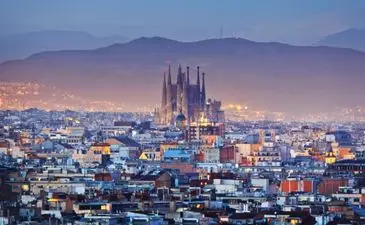
La Sagrada Família is the sacred centre of not only Barcelona but also Catalonia. There are sometimes so many tourists there to worship the work of Antoni Gaudí, the pioneer of Catalan Modernism who designed it, you can forget that it’s also an important place of worship. One of the most beautiful basilicas in the world, it combines Gothic and Art Nouveau styles with an homage to nature. With intricate details of the nativity, Passion and so many more, you can spend all day seeking out all of its symbolism. The other fascinating detail about the Sagrada Família is that it’s still a work in progress, and has been since 1882.
Iconic parks
Some of the world's most famous parks are located right in the heart of Barcelona. Such as the iconic Park Güell where you can take in some of Gaudí’s most iconic works alongside brilliant views of the city; or Parc de la Ciutadella, a laid back luscious hangout with a boating lake and a fountain, Cascada Monumental, co-designed Gaudí. Jardines de Mossèn Costa i Llobera is another favourite, named after a famous Catalan poet, this park houses plants and flowers from all over the world but is best known for its over 800 different varieties of cacti overlooking picturesque views of the city and the Mediterranean.
Casa Batlló
This is another Gaudí great and sometimes considered his most imaginative, while also being totally immersive. It’s like an episode of Grand Designs gone mad, as Gaudí and his team created a roof to resemble the scales of a dragon, the building is as curvaceous as it is osseous (it’s nicknamed the house of bones, or Casa dels Ossos), and its exterior is covered in magnificent mosaics meaning that it shimmers in the sunlight. Don’t miss going inside to see its central courtyard that acts as a natural lightwell, as well as so many more magical moments.
Las Ramblas
Get ready to rumble when you head to Las Ramblas, the most famous shopping street in Barcelona which is like a mini city all on its own. Because it’s not just one BCN boulevard, it's actually a series of five distinct sections, each with its own character, blending into a single, lively promenade that stretches 1.2km from Plaça de Catalunya to Port Vell. Once a former riverbed, it’s now a river of street performers and artists, street food, the Gran Teatre del Liceu opera house, and Plaça Reial with palm trees, bars and fine architecture.
Best way to get around Barcelona
If it’s your first time to Barcelona, it may be bigger than you think it’s going to be. At over 100km2, it has 66 museums and a similar number of parks and gardens. So be prepared to walk, wade through its myriad public transport options, and then recover at its 4.5km beach. Because if in doubt, there’s always the beach. Public transport: Barcelona's public transport system is extensive and efficient, featuring a comprehensive metro network, over 100 bus routes, trams, local trains (FGC and Rodalies) for suburban and regional connections. The Barcelona Metro has 12 lines (L1–L12), covering the city and suburbs, and it’s easy to navigate. Although, unlike the city itself, it goes to sleep by midnight on weekdays and 2AM on weekends, there are night buses which run all night. The TMB app is the best way to pay for public transport when exploring Barcelona although you can also buy a T-mobilitat card, which you can top up as needs be. By bike and scooter: Barcelona’s shared transport schemes are made up of AMBici electric bikes and also several companies offering shared e-scooters. In addition, there are several guided cycling and e-scooter tours that you can take. By cable car: Don’t miss the Montjuïc Cable Car (Telefèric de Montjuïc) which takes you up from Paral·lel metro station to the top of Montjuïc Hill, with superb views across the whole city along the way. Once you get up to the top, you have attractions such as Montjuïc Castle, the Magic Fountain, former Olympic facilities and some parks to chill out at.
Best food and restaurant areas in Barcelona
There is food everywhere in Barcelona and, not surprisingly, the city’s Catalonian influences inform the gastronomy big time. There is no shortage of Michelin Stars in Barcelona, with over thirty at the last count, the one of the most recent being Quirat, by Víctor Torres and Suto, by Yoshikazu Suto. The latter is close to Barcelona-Sants station too. For more local and internationally-influenced food scenes, and at a cheaper price tag, Mercat de la Boqueria on La Rambla is famously delicious, but there are plenty of other street food markets in the city too. These include Mercat de Sant Antoni in Poble Sec which is also the most voracious area in terms of its appetite for new foodie hangouts. Its tapas bars along Carrer de Blai are considered the best in the city by many. Santa Caterina Market near Barcelona Cathedral has a mix of fruit, veg and fixed price lunch menus (menú del día) at Bar Joan. Mercat de la Llibertat in Gràcia dates back over 120 years, and it’s a real fruit, meat and fish place, but with plenty of opportunities to fill a picnic hamper. And Mercat de Sants near the main station is not to be missed either with an array of hams, cheeses and breads to make your own bocadillo, or good-to-go stews and empanadas too. Gràcia is also a residential area and so there is no shortage of small, family-run restaurants catering for all tastes and budgets. It’s low-key but with high standards, and you’ll find a mix of traditional Catalan cuisine, and an array of veggie options. El Born is one of the most talked about barrios for fine bites, and with a young, creative energy too. Expect a mix of traditional tapas with some other worldwide influences, and plenty of tucked away tuck shops too. You'll find a mix of traditional Catalan tapas and modern experimental dishes, often served in chic bohemian settings. For seafood, head to La Barceloneta, Barri Gòtic and the recently revitalised industrial area of Poblenou, a district of casual beachside eateries.
Best neighbourhoods to stay in Barcelona
It can feel tough to find the best neighbourhood to stay in Barcelona, because it’s much bigger than people who are new to Europe might imagine. To put it in context, it’s similar to Boston in land area, but three times as dense. If you’re a BCN baby and new to it all, being in the centre is probably the way to go, so you can just dive into the action. The different neighbourhoods are called barrios, and the most famous one is the Barri Gòtic, which is in the historic heart with Barcelona Cathedral, Plaça Sant Jaume and the Roman ruins on your doorstep. Eixample and El Born are also perfect for first timers, the former being a little quieter at night than the Gothic Quarter, but still home to classics such as Gaudí's Casa Batlló and La Pedrera, as well as some great restaurants and shopping stops. El Born is for those who are born to enjoy bellinis, boutique shops, art and parks. If you’re on a tighter budget, one of the best neighbourhoods to stay in Barcelona is Poble Sec, an up-and-coming, foodie-friendly fun part of town, also known for its tapas bars along Carrer de Blai. Nearby Sants-Montjuic is also a great area to stay, famous for its cable car but also green areas such as the Olympic Park, pool and museums. Busy by day but much quieter at night. You can’t walk to the main tourist sites, but you can sit in wonder at the views by night. Poblenou is becoming the industrial regeneration cliché (but in a cool way) with old factories that are now co-working spaces, art galleries, and hip hangouts but also close to Bogatell and Mar Bella beaches. For more of a village vibe, Gràcia has pretty squares with artsy cafés and small, locally-owned shops, it’s close to Park Güell and it’s popular with families.
Good day trips from Barcelona
Figueres
Located within Spain's Costa Brava region, Figueres is a small town with a big claim to fame. The birthplace of surrealist Salvador Dalí, Figueres’s main attraction is the extraordinary Teatre-Museu Dalí, a monument to Dalí’s singular craft and a journey into his flamboyant imagination. After taking in some art, wander down Figueres’ Rambla, a long pedestrianised walkway, which is far less touristy than Barcelona’s busy counterpart now infamous for its overtourism. Getting there: Trains from Barcelona to Figueres by train are very regular and the journey takes around 55 mins.
Girona
Girona, Northern Catalonia’s biggest city, offers a treasure trove of museums, Gothic churches and art galleries, all connected through a network of charming cobblestone streets. Marvel at the multi-coloured houses sitting alongside ancient cathedrals on the banks of the River Onyar, before stepping back in time with a visit to the Old Jewish Quarter and the 12th-century Arab Baths. Consider visiting Girona in May when the annual flower festival, Temps de Flors, makes the entire city bloom. Getting there: Travel from Barcelona to Girona by train in 38 mins, with trains at least once an hour.
Tarragona
This ancient city has a unique combination of beautiful beaches and Roman ruins. Wander down the port city’s cobbled lanes, stopping in at the Roman amphitheatre and mosaic museum, before feasting on fresh fish in the city’s medieval centre. Tarragona’s towering cathedral is a highlight, as is the Pont del Diable (Devil’s Bridge), an aqueduct included in the city’s ensemble of UNESCO World Heritage sites. Getting there: There are many trains a day between Barcelona and Tarragona, and the journey takes on average 32 mins.
Montserrat
Meaning ‘serrated mountain’ in Catalan, Montserrat is a popular day trip destination for travellers visiting Barcelona, accessible by train from Plaça d’Espanya to Montserrat-Aeri in just over an hour. This is a local train which is bookable locally. From there, take the cable car up 1,236m where the Santa Maria de Monsterrat monastery sits atop the mountain. One of Catalonia’s most sacred religious sites, it also offers breathtaking views of the surrounding Catalan region, although the mountain tends to get overcrowded in peak tourist periods. Getting there: Take the local R5 train from Plaça d’Espanya to Montserrat-Aeri in just over an hour, and take the cable car from there.
Sitges
This is the beach day trip favourite for Barcelona locals, so be warned it can get busy in peak season. It’s a traditional beach resort with white sands, the iconic Church of Sant Bartomeu i Santa Tecla which overlooks the sea, shabby chic flamboyant buildings many of which have now been revived by boutiques and clubs of a very vibrant gay scene. It’s just 35km south of Barcelona and, with its Mediterranean climate, it’s popular all year round. It’s also hopping with events, such as the Sitges International Film Festival in October, the Jazz Antic Festival in April when musicians fill the streets and of course, Carnival in February, said to be one of the best in Catalonia. Getting there: Take the local train from Barcelona-Sants to Sitges.
Best time of year to visit Barcelona
Barcelona starts to really shine from about March onwards, when temperatures are already as high as 15C, increasing by a couple of degrees every month, with top temperatures hitting around an average of 30C in July and August. July and August are also the steamiest months in terms of visitor numbers, so it’s best to travel outside those times if possible. Barcelona loves its religious and cultural festivals, as well as musical ones. If your visit to Catalonia falls on 23 April, this is the festival of Sant Jordi, which is not only Catalonia’s own saint’s day, but also a bit like Valentine's Day, as he is also the patron saint of lovers. Catalans combine romance with culture, however, as this is also World Book Day. Tradition has it women give a book to men while men give roses to women, so the streets are full of books and flower stalls. Carnival in Barcelona is a camp and colossal event, and one big party that dates back to the 1850s, (although banned under Franco’s regime), when Christians let it all go before reining it in for Lent. This means the seventh Tuesday before Easter Sunday, so it usually falls in February but sometimes in March. Easter is a slightly more serious and ceremonious affair, but Semana Santa, as it’s called in Spain, is a whole week of processioins and religious passion. For a very different type of passion, Primavera Sound is Barcelona’s biggest music festival, around the beginning of June, and the whole city rocks during this time. Especially Parc del Fòrum, where it’s all happening.
Exploring Spain by train
With such an extensive rail network, it’s also very easy to explore other sights and cities within Spain. As well as our day trips above, here are some of our favourite towns and cities to visit.
Madrid
Spain’s bustling capital is a place for Bourbon style, serious culture, sport aplenty and some of Europe’s best bars and cafés. As the hub of Spain’s impressive high-speed rail network, devotees of Spanish rail travel inevitably return to Madrid time and time again. It’s a wonderful city, a place that deserves a week or more, but even an overnight stay is enough to catch the flavour of Madrid. Do it once, and you’ll be hooked. Cultural highlights include the celebrated Museo del Prado, the Palacio Real, the iconic squares Puerta del Sol and Plaza Mayor and the Reina Sofía Museum of modern art. Train lovers may like to visit the Museo del Ferrocarril (Railway Museum) located at the old Delicias station. For more information, see trains to Madrid.
Seville
Seville is the capital of Andalucía, the fourth largest city in Spain and is, quite simply, the perfect place to chill. The home of flamenco also claims to have the best tapas in Spain. It boasts a mix of Islamic heritage and also Christian ones, with the city’s Royal Alcázar of Seville and its 15th-century cathedral just two examples of both. Seville is a sophisticated but also chilled city to wander around, with other interesting highlights including the tomb of Christopher Columbus and the Barrio Santa Cruz area with its labyrinth of narrow alleys. For more information, see trains to Seville.
Valencia
Spain’s third-largest city is a star. Valencia is a cosmopolitan, cultural hub that tops many travellers’ lists of their favourite Spanish cities. Urban regeneration has pushed Valencia into the spotlight, and it’s now a great spot for a city break or longer stay. Locals speak both Spanish and Valencian – the latter a dialect of the Catalan language. Take time to wander through the atmospheric centrally-located Barrio del Carmen to see the eye-catching modern architecture in the CAC district; the latter rates as one of Europe's major investments in culture and the creative industries. One of the greatest historic cultural highlights is La Lonja de la Sedaor, or Silk Exchange, a stunner of a building and UNESCO World Heritage Site. For more contemporary but equally iconic architecture, don’t miss the Science Museum. For more information, see trains to Valencia.
Bilbao
Bilbao is the largest city of the Basque province and a world apart from the sunny south.The stunning Guggenheim Museum pulls the crowds, but make time for the Old Town (Casco Viejo) too. And also for a stroll along the Ría de Bilbao, where the promenade has great views of both modern and historic Bilbao. Highlights include Zubizuri Bridge by Santiago Calatrava and Isozaki Atea towers. For a very different view, take the funicular to the top of Mount Artxanda. And, after all that exploring, Bilbao also packs a culinary punch from the fresh produce of Mercado de la Ribera to the pintxos (Basque-style tapas) in many bars across the city. Top spots include Plaza Nueva in Casco Viejo. Pair them with a glass of local txakoli wine or Basque cider. For more information, see trains to Bilbao.
Granada
Granada is famous for its Moorish heritage, and most particularly for the Alhambra complex. Real devotees of Granada often assert that this is by far the finest city in all of Spain. It is certainly remarkable, well-deserving of a stay of two or three days. The Alhambra is just the start - and even that is much more than merely one palace. It is a huge complex stretching from the old Alcazaba fortress through the royal palaces to the shady gardens of the Generalife. On the far side of the River Duoro from the Alhambra is the Albaicín Quarter. Granada is made all the better by its setting, right in the shadow of the magnificent Sierra Nevada. For more information, see trains to Granada.
Scenic train routes in Spain
There are so many magnificent routes through Spain, thanks to its spectacular array of landscapes, all beckoning for adventure and culture. One of our favourites is a sunset one, on the final part of a rail journey from Seville to Cádiz, along the Atlantic coast of Andalucía. The last vineyards of the Jerez region give way to estuarine mudflats, saltpans and water meadows, as the sun gives way to night. For more information, see the train from Seville to Cádiz. For a much longer train journey through Spain, and we’re talking 13 hrs of Spain at its slowest and most sublime, you start in Barcelona and end in Cadiz, but not taking high-speed trains at all. This is like an analogue adventure in the train world. The train is called Torre del Oro and it’s direct, but it’s also hard to find a booking for it, as the tickets aren’t always regularly released and it’s at 07:45h. It’s worth it though, as it takes you through landscapes such as the Ebro Delta, the Serra del Montsià, the arid landscapes and windmills around Alcázar de San Juan and also the dramatic views of Despeñaperros Gorge. For more information, see the (slow) train from Barcelona to Cadiz.
Train passes for tourists in Spain
The Eurail or Interrail Spain One Country Pass offers unlimited train travel across Spain, ideal for exploring its diverse cities, beaches, cuisine and UNESCO World Heritage sites. Visit Valencia’s avant-garde buildings, Barcelona’s Sagrada Família and Madrid’s flamenco clubs with the freedom to hop on and off trains without distance limits. The pass includes bonuses like hotel discounts, reduced museum fares, free ferry trips and more. Perfect for adventurers and planners alike, it’s your key to an unforgettable Spanish odyssey. For more details, see our Spain Pass guide.
Travel to Barcelona by train from anywhere across Europe.
Von Madrid nach Barcelona mit dem Zugfrom 5,64 € |
Von Montpellier nach Barcelona mit dem Zugfrom 26,45 € |
Von Paris nach Barcelona mit dem Zugfrom 51,16 € |
Von London nach Barcelona mit dem Zugfrom 73,70 € |
Von Avignon nach Barcelona mit dem Zugfrom 13,87 € |
Von Toulouse nach Barcelona mit dem Zugfrom 54,19 € |
Von Narbonne nach Barcelona mit dem Zugfrom 36,85 € |
Von Lyon nach Barcelona mit dem Zugfrom 13,44 € |
Von Perpignan nach Barcelona mit dem Zugfrom 27,31 € |
Von Bilbao nach Barcelona mit dem Zugfrom 36,42 € |
Von Brighton nach Barcelona mit dem Zugfrom 279,20 € |
Von Bath nach Barcelona mit dem Zugfrom 158,68 € |
Von Marseille nach Barcelona mit dem Zugfrom 71,97 € |
Von Lille nach Barcelona mit dem Zugfrom 104,05 € |
Von Salou nach Barcelona mit dem Zugfrom 8,19 € |